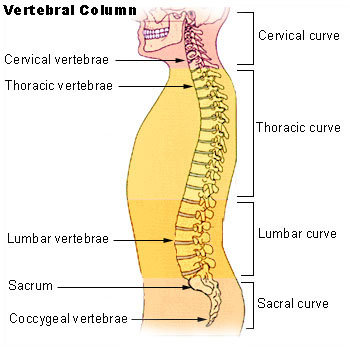
Today's post focuses on your spine. Your spine is a masterful piece of biomechanical engineering! It's the bony armor that houses and protects your spinal cord. It bends forward, backward, side-to-side, and rotates. Without getting too "sciency," you need to know that your spine starts at the top of your neck (about ear-level) down the bottom to your tailbone. Your spine has three main regions of consisting of 24 articulating (moveable) vertebrae.
The Cervical spine has 7 vertebrae (C1-C7), that you know as the neck bones. If you touch your chin to your chest and put your hand at the bottom of the back of your neck, the bump you feel sticking out is your C7 vertebrae.
The Thoracic spine has 12 vertebrae (T1-T12). T1 is at the top of your ribcage and T12 is at the bottom of your ribcage.
The Lumbar spine has 5 vertebrae. You know this region as your lower back.
I use "Breakfast, Lunch, and Dinner," to help me remember the numbers. You have breakfast at 7, lunch at 12, and dinner at 5.
Sorry for the anatomy lesson, but you need to understand how your body is built if you want to improve its performance. You'll often hear your coaches mention "neutral spine" or "flat back." As you can see from the picture above, each region of the spine has its own curve. The picture shows what a neutral spine is supposed to look like. When a coach tells you "flat back," they don't want you to have a perfectly flat spine, because your spine naturally has these curves. That being said, you should not have any change in you spinal position when you are performing your WODs. Watch this MWOD video about the "One Joint Rule." Basically, there should not be any change within the curves of your spine.
Your spine is the chassis for the two main movers of the body, your hips and shoulders. If your spine is in a bad position, then your hip and shoulder power output will suffer accordingly. Get your spine organized first, and you will set up your hips and shoulders for better performance. Watch the video below to get a better understanding on how a properly organized spine affects your performance. When you go back to the box, try to get into, and maintain proper spinal position when performing your WODs.
Centurions, we're starting a new weekly post (every Sunday) that will hopefully educate and motivate you to learn about moving your body, understanding the mechanics behind that movement, and offer some techniques to help fix any limitations or issues you may have.
The majority of the information posted on Supple Sundays will come from MobilityWOD. It has hundreds of videos that you can watch that cover movement, mobility, flexibility, and stability of every joint, every muscle, and the body's fascial system. Go there today and search the videos for the joint, body part, or movement that is either causing you pain or you struggle with performing at the box.
We're in the second week of the CrossFit Games Open, with WOD 14.2 having the overhead squat at a moderately heavy weight. The overhead squat is the ultimate core exercise, the heart of the snatch, and peerless in developing effective athletic movement. The overhead squat also demands and develops functional flexibility, and similarly develops the squat by amplifying and cruelly punishing faults in squat posture, movement, and stability.
Bottom position of the overhead squat.
Some athletes have a problem getting into the bottom position of the overhead squat, some don't. For those that do, don't be disheartened. You CAN improve your overhead squat, you just need to put in the deliberate practice to get there. The foundation to a good overhead squat is a really good air squat. That's why the air squat is the very first movement we teach at the Foundations class. Master this movement, and you've got the keys to the kingdom. If you struggle with your air squat, you will struggle even more in the front/back/overhead squat.
Many moons ago, your air squat looked this good without even trying!
So let's go back to beginning. The picture above shows the major points of performance for the air squat performed by someone who can't even spell the word "WOD." No matter how bad (or how good) you think your squat may be, chances are, you can make it better. Some athletes may have pre-existing medical conditions (surgery) that may constrain them in one way or another, but for about 98% of us, the inability to achieve and maintain a rock solid bottom position in the squat is something that we can address with mobility work and practice.
So if you want to have a rock-solid bottom position of the squat that would make junior up there jealous, you actually need to spend some quality time IN the bottom of the squat. Yes, it's probably going to be uncomfortable, but if it were easy, then you wouldn't walk into the box day after day. So here's your homework for today: Watch the very first MobilityWOD video ever made:
Then practice spending some time in the bottoms of the squat (we encourage you to start today!). You WILL start to notice increased range of motion in your hips, your knees, and your ankles!!
Here are some things to remember:
You can include some mobility elements in your warm up, but not in place of warming up.
Get sweaty before you start doing mobility work. A good 500m row works great.
You'll want to leave anything that hits deep for after your workout. Don't do a 10-minute squat test before a WOD!!
Yes, you can do mobility following your workout or at a completely different time.
You can hit different things at different time throughout the day.
As you are working with an area you will see the benefits last longer. In the beginning the change may not last as long as you think it should. As you work with it and your body learns the new position/movement pattern it will stay longer. After things get worked out and the area isn't as tight any longer it will be more maintenance and staying on top of it.
If you have any questions, please comment on the blog, on FaceBook, or ask any of your Centurion coaches. Additionally, take a look at the mobility posters that are hung over the bumper plates. There's a plethora of information there!!